
Storm-Damaged Trees in Northern New York: When You Need Removal and Stump Grinding — Not Just a Trim
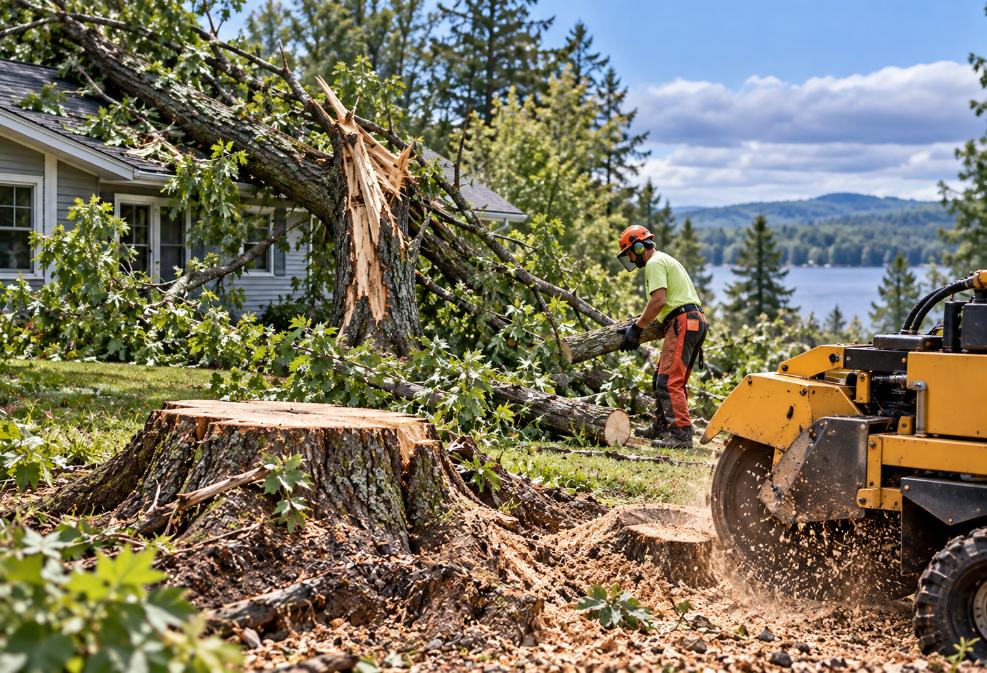
A strong windstorm, heavy snow, or ice event can turn a healthy-looking tree into a property hazard in a matter of hours. Across Northern New York, where mature trees, wooded lots, winter weather, and exposed rural properties are common, storm damage is not always something that can be solved by cutting off a broken branch.
Sometimes trimming is enough. Other times, removing the damaged tree and grinding the remaining stump is the safer and more practical long-term solution.
Quick answer: A storm-damaged tree generally needs removal when the trunk is severely split, the tree has become unstable, major structural limbs have failed, roots have lifted or shifted, or the remaining tree poses an ongoing risk to nearby buildings, vehicles, utility lines, or people. Minor branch damage may be handled with pruning if the tree remains structurally sound.
What local property owners should know
-
A few broken branches do not automatically mean an entire tree must be removed.
-
Trees that lean suddenly after a storm may have root or soil damage that cannot be corrected by trimming.
-
Heavy snow and ice across Clinton County, Essex County, and Franklin County can place substantial weight on large limbs.
-
Removing a damaged tree without addressing the stump can leave an obstacle that interferes with mowing, landscaping, and future use of the area.
-
Damage near a home, driveway, road, or utility line deserves more attention than similar damage in an isolated wooded area.
Why Storm-Damaged Trees Are a Particular Concern in Northern New York
Storm-damaged trees are a local concern because Northern New York properties experience snow loading, ice, high winds, saturated ground, and repeated freeze-thaw conditions throughout the year. Those conditions can expose weaknesses in trunks, roots, and large limbs that were not obvious before the storm.
Properties around Plattsburgh, Peru, Saranac, Champlain, and other communities near Lake Champlain can include mature trees exposed to wind as well as trees growing close to homes and driveways.
Farther toward the Adirondacks, wooded properties may have a different problem. Trees can be closely spaced, making it difficult to see whether a damaged trunk or hanging limb is creating a hazard until another wind or snow event moves it.
Rand Hill Lawns Inc. helps property owners evaluate outdoor property needs after damaging weather. When tree removal and stump grinding are appropriate, we can help restore a safer, more usable landscape rather than leaving a damaged tree or stump to become a continuing property concern.
Local Field Observation: Storm Damage Is Not Always Visible From the Ground
The most important storm damage is often structural rather than cosmetic. A tree may still have green leaves and a full canopy while containing a split trunk, partially detached limb, damaged root system, or weakened connection between major branches.
After Northern New York storms, property owners may naturally focus on branches already lying on the lawn. The more important question is what remains overhead.
A broken branch caught in another limb, a newly opened crack in the trunk, or a tree that has shifted at ground level can require more attention than scattered debris.
That is why evaluating the entire tree matters before deciding that cleanup and a simple trim are enough.
How Storm-Damaged Trees Can Affect Your Property
A damaged tree can continue affecting a property long after the storm itself has passed. Even when nothing falls immediately, weakened limbs or trunks can become more vulnerable during the next period of wind, snow, or ice.
For local homeowners, damaged trees can affect driveways, garages, roofs, fences, lawns, parked vehicles, and outdoor living areas. On rural and wooded properties, they can also block access lanes or interfere with regular mowing and grounds maintenance.
Commercial properties face similar concerns. A weakened tree near customer parking, walkways, entrances, or service areas may interfere with normal property use until the damage is addressed.
Warning Signs That a Tree May Need More Than a Trim
A tree may need removal rather than ordinary pruning when the damage affects its basic stability or structure. Watch for these signs after severe Northern New York weather:
-
The trunk has a large vertical or horizontal split.
-
The tree developed a noticeable lean that was not present before the storm.
-
Soil around the base has lifted, cracked, or shifted.
-
Large roots are exposed or appear torn.
-
A major portion of the canopy has broken away.
-
Large limbs are hanging or partially attached above buildings, driveways, or walkways.
-
The trunk has broken near its base or at a major fork.
-
The remaining structure appears heavily unbalanced after significant limb loss.
A small broken limb in an otherwise stable tree may only require proper pruning. Damage involving the trunk, root system, or major structural branches is a different situation.
When Should You Call a Professional?
Professional help is appropriate when storm damage involves large limbs, unstable trees, elevated cutting, nearby structures, or uncertain structural stability. Property owners can safely inspect a tree from the ground, but climbing a damaged tree or cutting a heavy suspended limb can create additional hazards.
Keep your distance from any tree or branch contacting a utility line. Tree damage involving electrical lines should be reported to the appropriate utility provider rather than approached or handled as routine yard cleanup.
For trees near homes in Plattsburgh or surrounding communities, professional evaluation is especially useful when the direction of a possible fall could affect a structure, roadway, driveway, or neighboring property.
What Commonly Causes Serious Tree Damage in Northern New York?
The most common causes of serious local tree damage include wind, heavy snow, ice accumulation, saturated soils, and preexisting weaknesses that become apparent during storms.
Heavy Wet Snow
Heavy snow can accumulate on broad canopies and large limbs. Trees with weak branch connections or existing damage may lose substantial limbs under the added weight.
Ice Accumulation
Ice adds weight throughout the canopy. Smaller branches may bend, while weakened or poorly supported larger limbs can crack or fail.
Strong Winds
Trees growing in open areas, near fields, along roads, or near the Lake Champlain corridor can receive significant wind exposure. Wind can break limbs, split trunks, or place pressure on compromised root systems.
Saturated or Disturbed Soil
Wet ground provides less support for some root systems. A tree that begins leaning after a storm may have moved below ground even if the trunk appears intact.
Existing Decay or Structural Weakness
Storms often reveal problems that were already developing. Cavities, old wounds, dead limbs, previous breakage, and weakened branch unions can become failure points during severe weather.
How Can You Reduce Future Storm Damage?
Regular observation and timely tree maintenance can reduce some storm-related risks, although no maintenance program can prevent every tree failure. Local property owners should inspect mature trees periodically and pay particular attention before winter and after major storms.
Look from the ground for dead branches, cracked limbs, damaged trunks, unusual leaning, and changes around the base.
Keep trees from becoming overlooked simply because they are at the edge of a large property. On wooded lots around Keeseville, Saranac, and the Adirondack foothills, trees near driveways, buildings, play areas, and frequently used portions of the property deserve particular attention.
DIY maintenance should generally remain limited to small, reachable branches that can be handled safely from the ground. Large limbs, chainsaw work above ground, and unstable storm-damaged trees are better left to experienced professionals.
What Should You Expect After Tree Removal and Stump Grinding?
Tree removal eliminates the damaged above-ground tree, while stump grinding addresses the portion left behind so the area is easier to maintain and reuse. The exact appearance afterward depends on the tree, stump size, surrounding terrain, root system, and intended use of the space.
Grinding a stump can reduce mowing obstacles and make future landscaping easier. It can also provide a cleaner result than leaving a cut stump in a lawn indefinitely.
Property owners should understand that stump grinding does not normally mean excavating every underground root. Roots can remain beneath the soil and gradually break down over time.
Common Mistakes After a Tree Is Damaged by a Storm
One common mistake is assuming that removing visible broken branches solves the entire problem. The consequence is that hidden trunk, root, or structural damage may remain. A better approach is to inspect the whole tree from the ground and seek professional help when major components are damaged.
Another mistake is cutting a compromised tree without considering its weight and direction of movement. A partially broken tree can behave differently from a healthy standing tree. The better approach is to avoid cutting unstable trees without the proper equipment and experience.
A third mistake is removing the tree but automatically leaving the stump. The stump may later interfere with lawn maintenance or landscaping. If the space is actively used, consider whether stump grinding should be completed as part of the overall project.
Common Northern New York Scenario
A common local scenario starts after a night of wind, snow, or ice. A homeowner walks outside the next morning and finds one large limb on the ground while another remains attached to the tree.
From a distance, trimming may seem like the obvious answer.
A closer ground-level look reveals that the failed limb originated from a major fork and opened a substantial split in the trunk. In that situation, removing another branch does not address the structural damage inside the tree.
If removal becomes necessary, grinding the stump afterward may also make sense when the tree sits in a maintained lawn, close to a driveway, or in an area the homeowner wants to landscape again.
Which Services Can Solve the Problem?
Tree removal addresses storm-damaged trees that cannot reasonably remain in place, while stump grinding addresses the remaining stump when property owners want a cleaner and more usable area afterward.
Pruning may still be the appropriate solution for limited branch damage when the tree remains stable. The goal should not be to remove every storm-damaged tree. It should be to match the service to the actual condition of the tree and the surrounding property.
Tree Trimming vs. Removal and Stump Grinding
Trimming is generally appropriate for limited damage to individual branches, while removal is more appropriate when the tree’s overall structure or stability has been seriously compromised.
Trimming preserves the tree and removes damaged portions when enough healthy, stable structure remains.
Removal eliminates the tree when continued failure is a concern or when storm damage has substantially affected the trunk, roots, or major framework.
Stump grinding is the follow-up option for property owners who do not want the remaining stump to interfere with mowing, appearance, or future landscaping.
The correct choice depends on the condition of the tree, not simply the amount of debris on the ground.
Where Do We Provide Storm-Damage Tree Services?
We serve property owners in Northern New York, including communities in and around Clinton County and the greater Plattsburgh area. Nearby communities such as Peru, Saranac, Champlain, and other surrounding service areas may also have properties affected by seasonal wind, snow, and ice.
What Can Happen If You Ignore a Seriously Damaged Tree?
Waiting can allow an already weakened tree or limb to face another round of wind, snow, or ice before the underlying damage is addressed. That does not mean every damaged tree will fail, but postponing evaluation can leave uncertainty around a tree located near frequently used parts of the property.
The practical concern is greatest around homes, garages, vehicles, driveways, walkways, and other areas where people regularly spend time.
Addressing damage early also gives property owners more control over cleanup and future landscaping rather than waiting for additional breakage.
Frequently Asked Questions
Does every storm-damaged tree in Northern New York need to be removed?
No. Many storm-damaged trees can remain if the damage is limited to individual branches and the trunk, major limbs, and root system remain structurally sound. Removal becomes more likely when damage affects the tree’s stability, involves a major trunk split, shifts the root system, or creates an ongoing property hazard.
Can a tree be saved after losing a large branch?
Sometimes. A tree that loses one large branch may remain viable when the trunk and remaining structural limbs are stable. The location of the break matters. A clean loss of one branch can be very different from a failure that splits a major trunk union or removes a substantial portion of the canopy.
What should I do if a tree starts leaning after a Northern New York storm?
Keep people and vehicles away from the potential fall area and have the tree evaluated. A newly developed lean can indicate movement in the root system or surrounding soil. This is particularly important after heavy rain, snowmelt, or wind when the ground around the roots may have shifted.
Should I remove a stump after taking down a storm-damaged tree?
Stump removal is not always necessary, but stump grinding is useful when the stump interferes with mowing, landscaping, walking areas, or future plans for the space. On maintained residential lawns around Plattsburgh and surrounding communities, grinding often creates a more practical finished area than leaving the stump in place.
Is it safe to cut broken tree limbs myself?
Small branches that are fully detached and safely reachable from the ground may be manageable, but large, suspended, or partially broken limbs should be treated cautiously. Storm-damaged wood can move unexpectedly. Avoid climbing damaged trees or working near electrical lines, structures, or heavy limbs without appropriate training and equipment.
Why do trees around Lake Champlain get damaged during storms?
Trees near the Lake Champlain region can experience combinations of wind, snow, ice, and changing soil moisture. The amount of damage varies by storm, tree species, location, exposure, and existing condition. Open properties and trees already containing weak branches or structural defects may be especially vulnerable when severe weather arrives.
When is the best time to check trees for storm damage in Clinton County?
Check trees from the ground after significant wind, ice, or heavy snow and again when seasonal conditions make the canopy easier to observe. You do not need to wait for a specific season when obvious damage is present. Cracks, leaning, hanging limbs, or root movement deserve attention when they are discovered.
Does stump grinding remove all of the tree’s roots?
No. Stump grinding generally reduces the stump below the surrounding surface rather than excavating the entire underground root system. Remaining roots typically stay beneath the soil. The final treatment of the area depends on future plans for the lawn or landscape.
Protect Your Northern New York Property After Storm Damage
A broken branch may only need proper trimming, but trunk splits, root movement, major structural failure, and unstable trees can call for a more complete solution. Evaluating the damage rather than simply cleaning up what fell helps property owners make a better decision for the tree and the surrounding landscape.
Clear Storm Damage and Restore a More Usable Property
We can help determine whether tree removal and stump grinding are appropriate for your Northern New York property.
Categorised in: Stump Grinding